





















It can be easy to lose track of a lesson, especially after spending over an hour with the same teacher. But for a typical high school student, this is the norm. In fact the average class at our school is over an hour, but a recent West Virginia Virtual Academy article states high school students’ attention span is about 10 to 15 minutes. Based on this, lengthy class periods aren’t benefiting students’ education, or even helping students comprehend their class material.
To hopefully adapt with this attention span crisis, there’s been recent consideration of a new schedule. The Arlington County School Board (ACSB) has proposed three new block schedules, each with shorter periods.
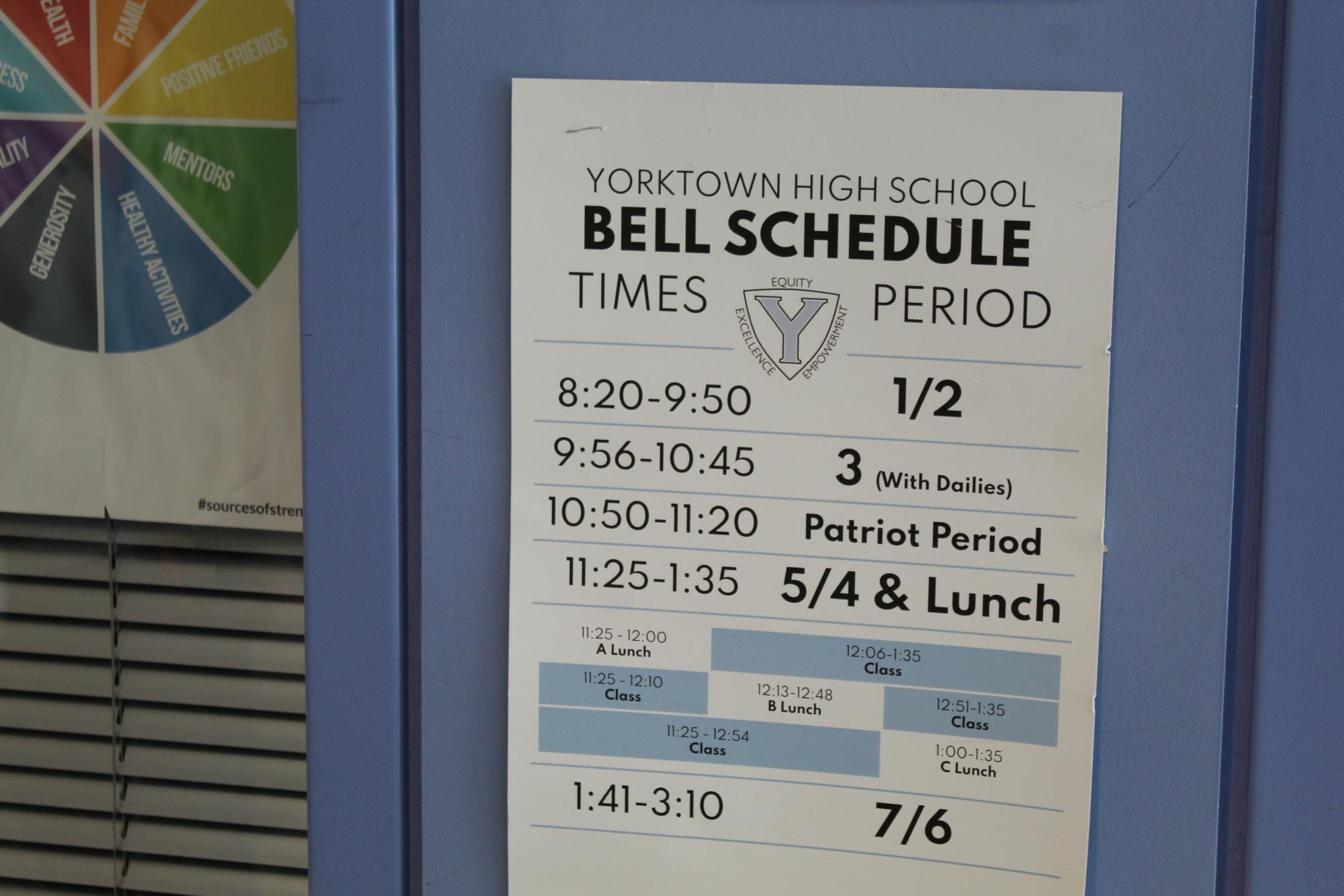
Our school currently follows a seven-period block schedule: three core classes in rotation and one shorter class everyday. The first schedule ACSB suggested only slightly alters this by simply incorporating one day a week with all classes.
Students at our school seem to favor this schedule.
“I think it would be good in the middle of the week to see all your teachers and have a chance to ask your teachers questions instead of using the Patriot Period,” sophomore Penelope Perez said.
Another offer is to rotate through every class everyday. This entails a four by four class rotation, meaning four long blocks everyday and no 45 minute periods. Lastly, they considered switching to a schedule similar to some Arlington Public Schools (APS) schools like the Arlington Career Center which utilizes a schedule with eight blocks. This has widely benefitted students who desire more room in their schedule to take an extra elective annually.
“If they added another class it would shorten the other classes so I think that’d be nice,” freshman Sienna Yang said.
The Board’s meeting soon took a twist as many of the 18 members struggled to understand the need for a switch. They had spent their meeting proposing alternatives, and they looked at the plethora of different schedules Virginia schools followed. However, the ACSB came to the conclusion that our current schedule is working without many complaints.
“What are the problems we’re trying to solve?” School Board chair member Bethany Zecher Sutton questioned in an ARLnow article addressing the block schedule.
It is true, we must address the attention span crisis; however, switching schedules also dispossess the consistency teenagers desire in daily education. In fact, a Walden University article states that there’s no direct correlation with higher achievement depending on school schedules. Factors like classroom environment and individual ability play a bigger role.
A new schedule would not only take students a while to adapt to, but also change the trajectory of learning.
“Shorter classes and more transition time actually takes away from that classroom time. Even though 45 minutes and 45 minutes are still 90, if your teacher’s doing a warm up everyday, which is best practice, that takes away from your class time,” assistant principal Laura Porter said.
Furthermore, 90 minute blocks sound treacherous; however, for certain courses it’s very beneficial. Take, for example, an intensive math class. Numerous math classes offered at our school require in depth lectures for students to fully comprehend the topic at hand. There’s so much material our math teachers have to cover in such a short time, therefore a longer class period is one way to get as much learning in as possible.
On the other hand, it’s proven that being taught math everyday has stronger outcomes for students.
“It’s important to have math everyday so you don’t have to think about what you did two days ago; you’re thinking about what you did the day before. They think that it might help if you stick with that longer,” Porter said.
Similarly students tend to have a more difficult time staying focused in classes with extensive material, like Advanced Placement courses. With intensive lectures, it’s a struggle for anyone to fully grasp every detail and concept over an hour and a half. For example, when asked how hard it is to focus during our longer class, Perez explained she couldn’t get through her class in the middle of the day without B-lunch splitting it up.
The benefits versus drawbacks to differing class lengths is endless, and what’s right for our school depends on who you ask. However, after following the seven-period block schedule for many years, we’ve not only adapted, but also thrived with it. Changing this routine has no firm evidence of higher student achievement, so it’s hard to find the value in fixing what’s working.